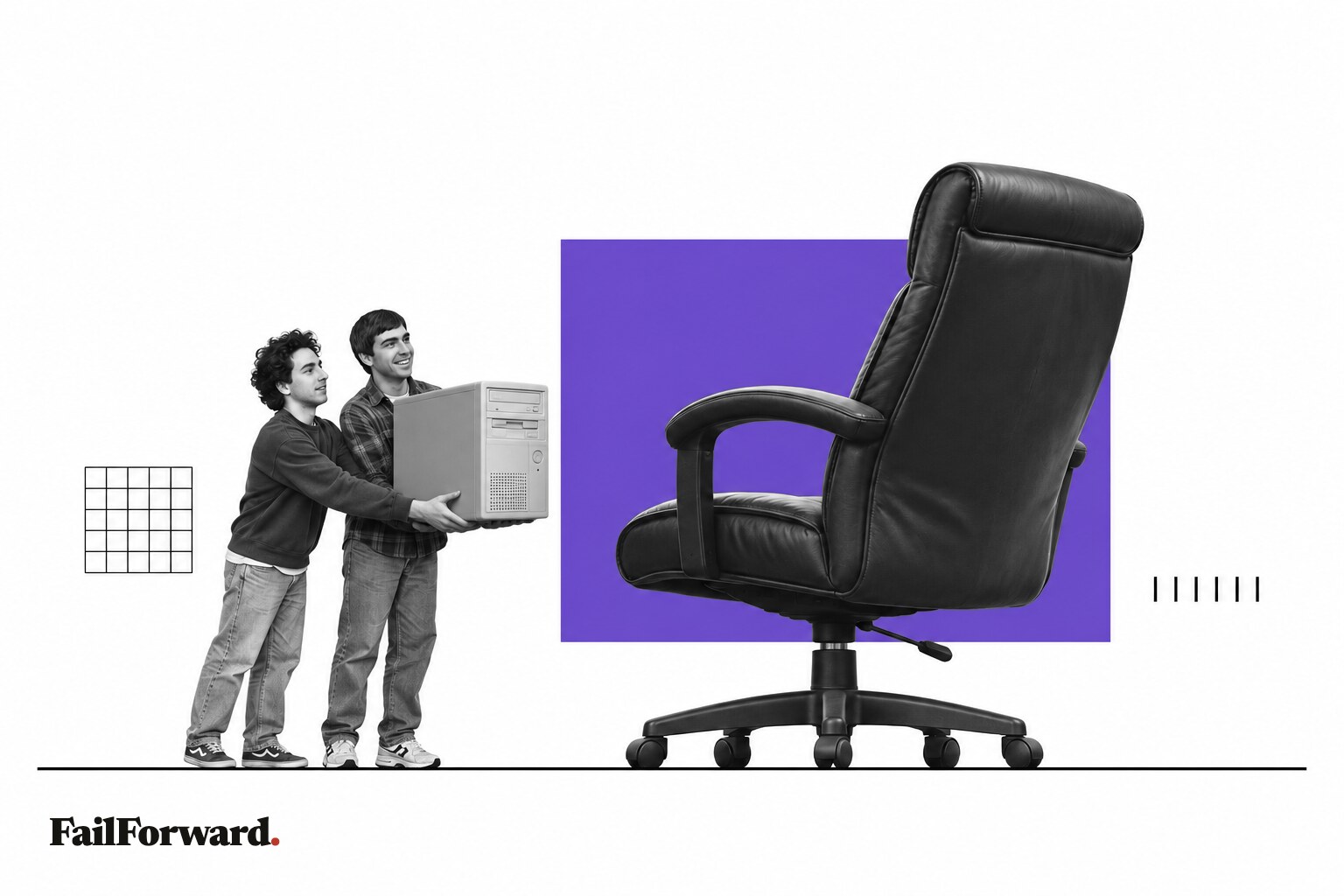
In January 1997, Larry Page wrote to Vinod Khosla, the Kleiner Perkins partner who had backed Excite, one of the original web portals. Page proposed that Excite buy BackRub, the search engine he had built at Stanford with Sergey Brin, for about $1.6 million. By his estimate it would lift Excite's traffic by 10% and its advertising revenue by $47 million a year. He would spend seven months at Excite, then go back to Stanford in the fall.
Page and Brin were 23-year-old computer science graduate students who had met at Stanford in 1995. Page, an engineering graduate of the University of Michigan, had found a way to rank web pages by the links pointing to them. Brin was born in Moscow in 1973 and was six when his family emigrated to the United States in 1979. His father, the mathematician Michael Brin, had not even been considered for graduate school in the Soviet Union because he was Jewish.
“We believe we are going to dominate the market — and if you believe that, it's hard for anyone to pay you enough to justify selling.”
Larry Page, asked by MIT Technology Review in 2000 whether Google got acquisition offersNeither was sure he wanted to run a company. Page's father, a computer science professor, had died in 1996, and friends recall that Page saw finishing his doctorate as something of a tribute to him; Brin, too, was reluctant to leave. Asked by MIT Technology Review in 2000 why they had started a company, Brin said: "For three years, we tried as hard as we could to avoid doing that." Instead they showed their technology to the search companies of the day — Infoseek, Excite and Lycos, as Brin later recalled. Excite was the most interested.
On stage with Khosla in 2014, Brin recalled the note they had sent him: "We really don't want to sell, but for $1.6 million, you got a deal." A reply accepting the price arrived within minutes. It had been faked by Scott Hassan, BackRub's main programmer. Khosla's real counteroffer, according to Steven Levy's 2011 book In the Plex, was $750,000.
Why Excite said no depends on who is telling it. Levy, citing Hassan, describes a test in the office of Excite's chief executive, George Bell. On the query "Internet", BackRub returned pages on how to use a browser; Excite returned Chinese-language pages. Bell was visibly upset: a search engine that good, he explained, would send visitors straight off Excite's site, and its advertising revenue depended on keeping them there.
Bell calls that "baloney." In his account, weeks of side-by-side tests showed little difference, the two sides settled on $750,000 in cash plus about 1% of Excite, and the deal collapsed over one condition from Page: "you need to rip out all the Excite technology and replace it with Google's search." "I chose culture over opportunity," Bell told CNBC in 2015. Khosla's summary, in 2014: management "felt that they didn't need it."
The most repeated version — $1 million, talked down to $750,000, in 1999 — fits poorly with the participants' memories: Khosla dates the talks to 1997, Bell to "maybe" 1998. Either way, nobody bought. In August 1998 Andy Bechtolsheim, a co-founder of Sun Microsystems, wrote a $100,000 check to Google Inc. before the company existed; Page and Brin incorporated it, moved into a Menlo Park garage owned by Susan Wojcicki and raised almost $1 million.
Bell says he gave Khosla's firm the green light, and in June 1999 Kleiner Perkins and Sequoia Capital led a $25 million round. A year later Yahoo made Google its default search engine. Google went public on August 19, 2004, at $85 a share, a valuation of about $23 billion. In January 2026 its parent company, Alphabet, passed $4 trillion in market value.
Excite merged with the cable internet provider @Home in 1999 in a $6.7 billion deal. In September 2001 Excite@Home filed for bankruptcy and agreed to sell its network to AT&T for $307 million; the Excite portal's assets went for $10 million. Page, by 2009, still had not finished the doctorate he had once wanted to go back to. That year the University of Michigan gave him an honorary one, and he told its graduates that his late father "would have been annoyed that I hadn't gotten my Ph.D. yet."
Questions
Did Google's founders try to sell it to Excite?
Yes. In 1997 Larry Page offered Excite the search engine he had built with Sergey Brin, then called BackRub, for about $1.6 million so he could go back to Stanford. Excite turned it down.
How much could Excite have bought Google for?
About $750,000. Page asked roughly $1.6 million; Excite's investor Vinod Khosla countered with $750,000, and Excite CEO George Bell remembers terms of $750,000 in cash plus about 1% of Excite before he said no.
Why did Excite turn down Google?
Accounts differ. Steven Levy wrote that Excite CEO George Bell found the engine too good, since it would send users off Excite's site; Bell says the deal fell apart over Larry Page's demand that Excite replace its own search technology with Google's.
Sources
- Fireside chat with Google co-founders Sergey Brin and Larry Page — Khosla Ventures, 2014
- The Real Reason Excite Turned Down Buying Google (interview with George Bell) — Internet History Podcast, 2014
- Larry Page Tried To Sell Google For $1.6 Million — Business Insider, 2014 (via Yahoo Finance)
- Dotcom Bubble CEO: Why I passed on buying Google — CNBC, 2015
- Search Us, Says Google — MIT Technology Review, 2000
- The Story of Sergey Brin — Moment Magazine