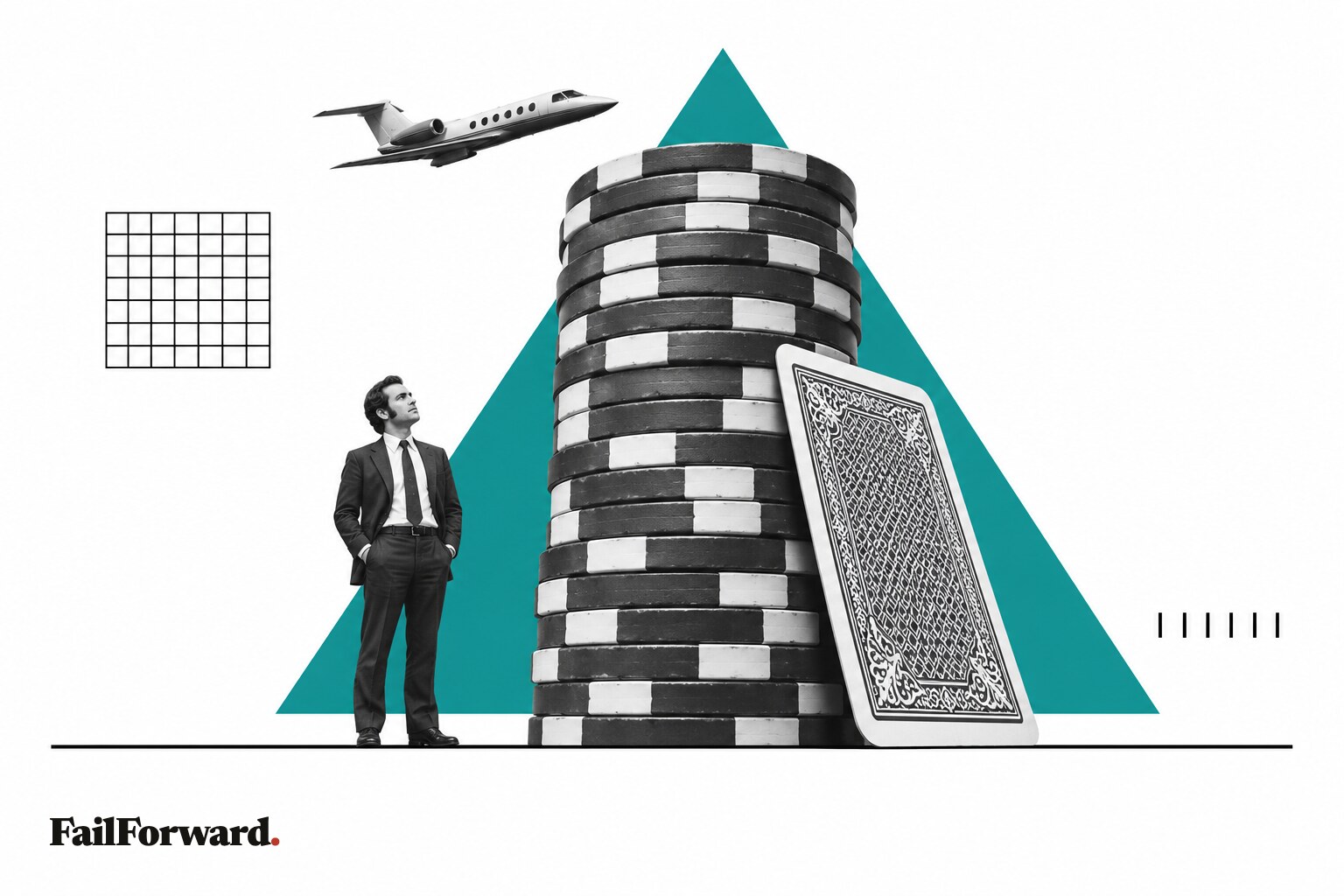
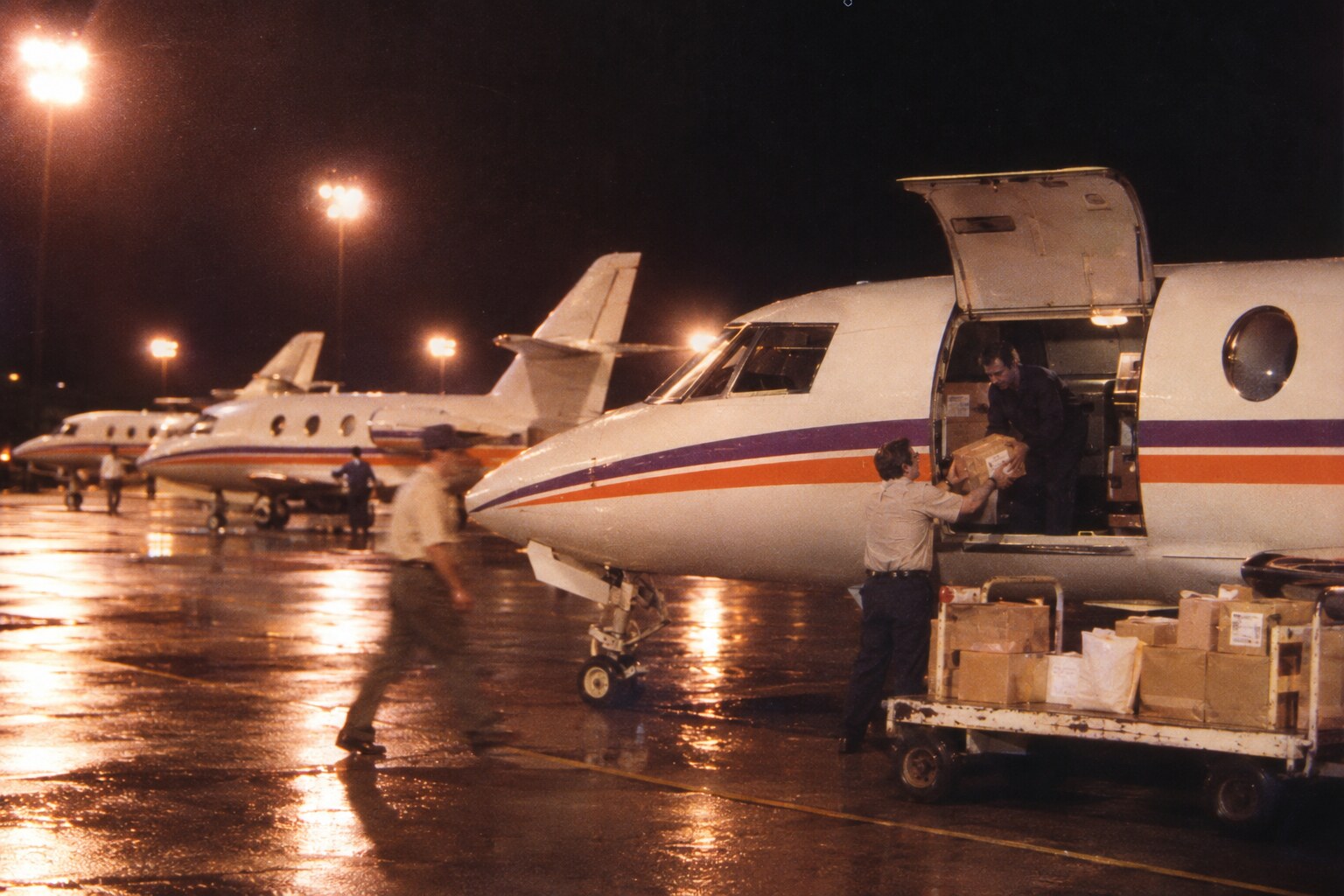
On the night of April 17, 1973, Federal Express began flying. Fourteen small Dassault Falcon jets, working through a hub at Memphis airport, delivered 186 packages to 25 American cities. Behind them stood 389 employees and a 28-year-old founder, Fred Smith, who had put most of a $4 million inheritance into overnight delivery.
Smith traced the idea to two sources. One was a paper he wrote as a Yale undergraduate in the mid-1960s: a computerized economy, he argued, would need a faster way to move what its machines depended on. Folklore says it got a C. In 1998 he recalled not getting "a particularly good grade"; in 2004 he told BusinessWeek the C began as an offhand reply to a reporter — "I don't know, probably made my usual C" — and that he still didn't know. The C first turns up in print in 1978.
“Although I won the money, we owed so much more money than that, it would have been a drop in the bucket.”
Fred Smith on Charlie Rose, May 2008The other was the Marine Corps: two tours in Vietnam, a Silver Star, a Bronze Star, two Purple Hearts and a close look at military logistics. In 1971 he founded the company, naming it Federal Express in the hope of a Federal Reserve contract that never came. With every package routed overnight through Memphis, the whole national network had to be paid for from the first night.
The bills came faster than the customers. Federal Express lost $29 million in its first 26 months; as fuel prices soared, by mid-1974 it was losing more than $1 million a month. Paychecks were sometimes postdated, and employees agreed to hold off cashing them.
The best-known episode comes from Roger Frock, one of the company's first executives, in a 2006 book. In his telling, fuel suppliers wanted each week's payment in advance on Monday — $24,000 at the time — and before one weekend the company had about $5,000. Smith had asked the board of General Dynamics for money and been refused. On Monday the account held $32,000. "I knew we needed money for Monday, so I took a plane to Las Vegas and won $27,000," Smith told him. It kept the planes flying for about another week.
Smith told the story himself, though never quite the same way. In 1981 he told The Washington Post he had flown to Las Vegas with $200, won $26,000 at blackjack and brought it home to help meet the payroll. On Charlie Rose's show in 2008 the stake was a few hundred dollars and a credit line of about $1,000, the win $25,000 — and the idea that it made the payroll was "not true at all." The company owed far more than that, he said; still, the story was true and probably mattered as a symbol.
What kept Federal Express going was other people's money. Smith had already raised tens of millions of dollars from banks and venture investors; in 1974 the original backers grudgingly added $11 million more, on hard terms. Smith later said that "everything was going wrong, except the fundamentals of the business were proving every single day that the idea was right."
The traffic did grow. The company made its first monthly profit in 1975; by late 1976 it was carrying about 19,000 packages a night, a hundred times the first night's load, and it earned $3.6 million that year. A 1977 law the company had lobbied for let it fly bigger planes, starting with Boeing 727s. It went public in 1978, and in 1983 became the first American company to reach $1 billion in annual revenue within ten years of start-up without mergers or acquisitions.
Smith ran FedEx until June 2022, then stayed on as executive chairman. He died in Memphis on June 21, 2025, at 80. By then the company that started with 186 packages was moving more than 17 million shipments a day, and for the fiscal year to May 2026 it reported revenue of $94.7 billion. The blackjack weekend is what people retell. By Smith's own account, it did not save the company. Investors who kept paying while the volume grew did.
Questions
Did Fred Smith save FedEx at blackjack?
Not by his own account. Smith did win in Las Vegas — $25,000 to $27,000, depending on the telling — while Federal Express was short of cash, but in 2008 he said the winnings would have been a drop in the bucket next to what the company owed.
Did Fred Smith get a C on his Yale paper about overnight delivery?
Nobody has confirmed it. In 2004 Smith said the C began as an offhand reply to a reporter — "probably made my usual C" — and that he did not actually know his grade; the C first turns up in print in 1978.
Is FedEx founder Fred Smith still alive?
No. Fred Smith died in Memphis on June 21, 2025, at 80. He founded Federal Express in 1971, ran it until June 2022 and then stayed on as executive chairman.
Sources
- Charlie Rose — Fred Smith, interview transcript (May 23, 2008)
- Academy of Achievement — Frederick W. Smith, interview (Jackson Hole, May 23, 1998)
- FedEx Newsroom — Frederick W. Smith, visionary founder of FedEx, dies at 80
- Priceonomics — How a Lucky Run in Vegas Saved FedEx (Roger Frock's account)
- Quote Investigator — "I Don't Know, Probably Made My Usual C"
- FedEx Corporation — Encyclopedia.com (International Directory of Company Histories)