The idea came from irritation. In the late 1970s, James Dyson — an industrial designer with one hit product already behind him, a barrow with a ball for a wheel — kept noticing his vacuum cleaner losing suction as its bag clogged with dust. Visiting a local sawmill, he watched a giant industrial cyclone spin sawdust out of the air all day without ever clogging. The question wrote itself: why doesn't a vacuum cleaner work like that?
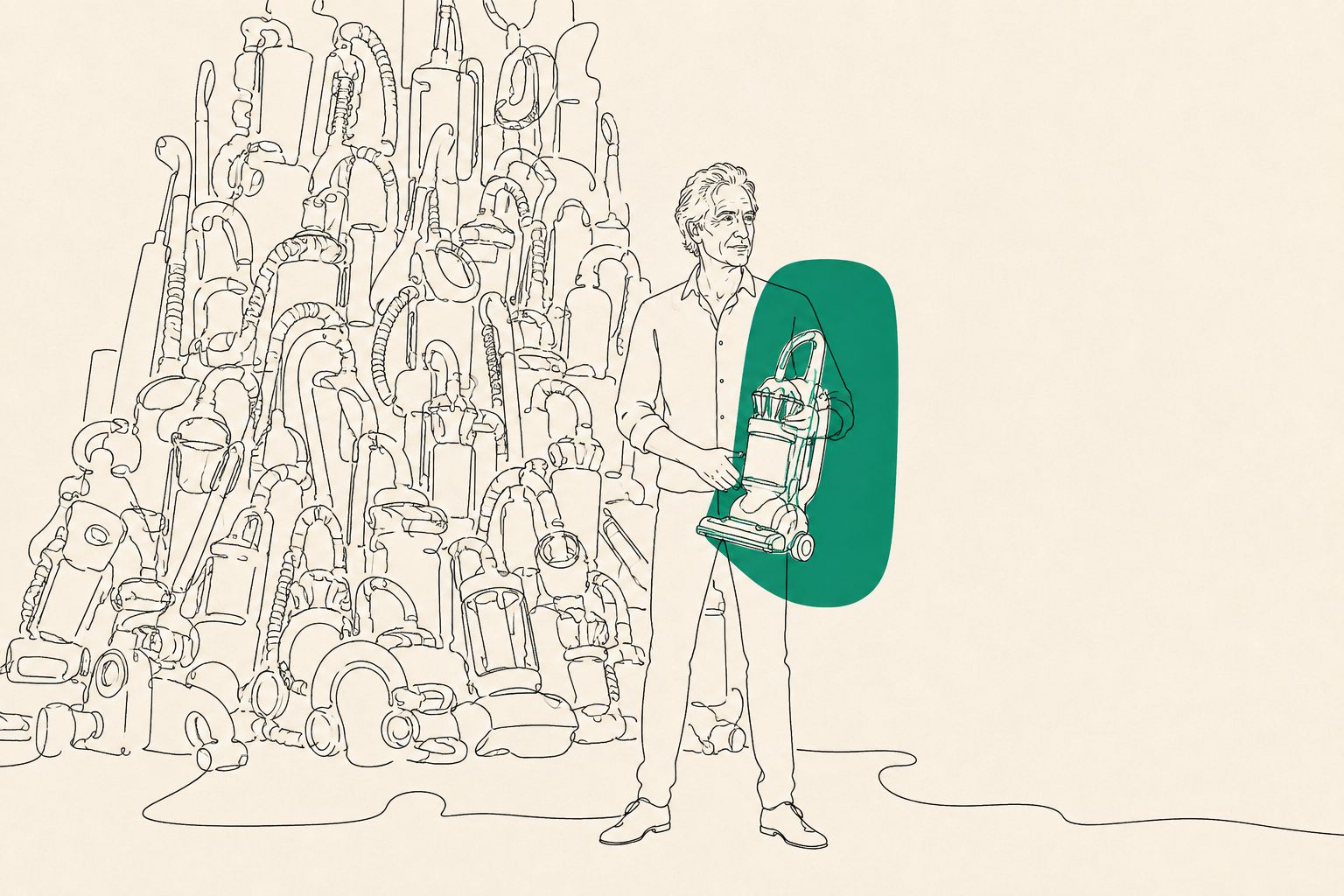
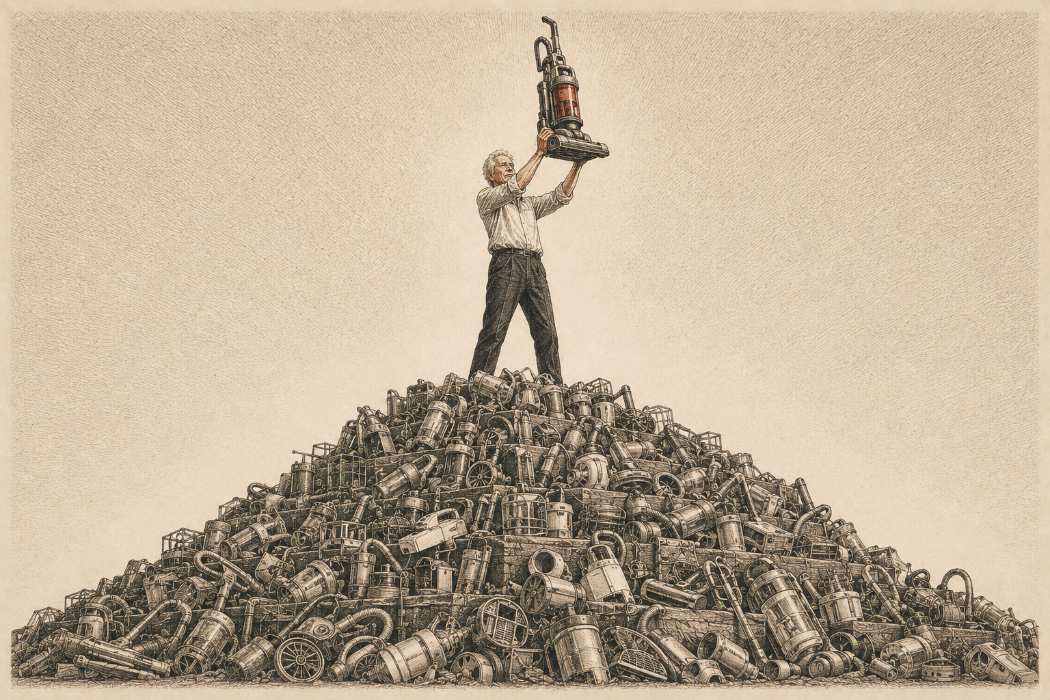
Answering it consumed five years of his life. In a coach house behind his home, supported by his wife's salary as an art teacher and by mounting debt, Dyson built cyclone after cyclone: cardboard, brass, aluminum, every geometry he could devise. He counted the failures the way engineers do — as experiments. There were 5,126 of them.
“I made 5,127 prototypes of my vacuum before I got it right. There were 5,126 failures. But I learned from each one.”
James Dyson, Fast CompanyPrototype 5,127 worked. What followed should have been the easy part and turned out to be a second education in rejection: the great vacuum makers of Europe and America — Hoover, Electrolux, the whole industry — declined to license the technology. Their reluctance had a simple structure: replacement dust bags were a wonderfully profitable business, and a bagless vacuum would kill it.
Blocked in the West, Dyson went east. In 1986 a Japanese company licensed the design and sold it as the G-Force — a striking pink machine priced around $2,000 that became a design-culture object in Japan and won a national design prize. The royalties gave Dyson exactly one shot at the thing he actually wanted: making it himself.
In 1993, fourteen years after the first prototype, he opened his own small factory in Wiltshire and launched the DC01 under his own name. British retailers hesitated; shoppers didn't. Within about two years the DC01 was the best-selling vacuum cleaner in the United Kingdom, outselling the very brands that had turned the technology away.
A Hoover executive later admitted on television, with painful honesty, that he regretted the company hadn't taken the technology — if only to put it on a shelf where no one could use it. It is among the most instructive confessions in industrial history: incumbents don't just miss disruptive ideas, they sometimes see them clearly and reject them to protect the business model the ideas would destroy.
Dyson never stopped iterating in public: cyclones gave way to digital motors, bladeless fans, hair dryers, robotics — and one famous, expensive failure, the cancelled Dyson electric car, which he shut down in 2019 having spent hundreds of millions of his own money. He wrote about it the way he writes about prototype 4,000: an experiment that returned an answer.
His company remains private, global and family-owned, and his telling of the origin story never varies in emphasis. Nobody remembers the vacuum that finally worked as vividly as he remembers the 5,126 that didn't — because, as he insists, those were the ones that contained the information.
Questions
How many prototypes did James Dyson make?
5,127: starting in 1979, James Dyson spent five years building prototypes of his bagless cyclone vacuum in a coach house behind his home. The first 5,126 failed; prototype 5,127 worked.
Why did Hoover and other vacuum makers reject Dyson's invention?
To protect their profitable replacement-bag business, which a bagless vacuum would kill, Hoover, Electrolux and the whole industry declined to license James Dyson's technology. He licensed it to a Japanese company and used the royalties to launch his own DC01 in 1993.
What Dyson products failed?
The Dyson electric car, a famous and expensive failure: James Dyson shut it down in 2019 after spending hundreds of millions of his own money. Before that, his bagless vacuum went through 5,126 failed prototypes until prototype 5,127 worked.