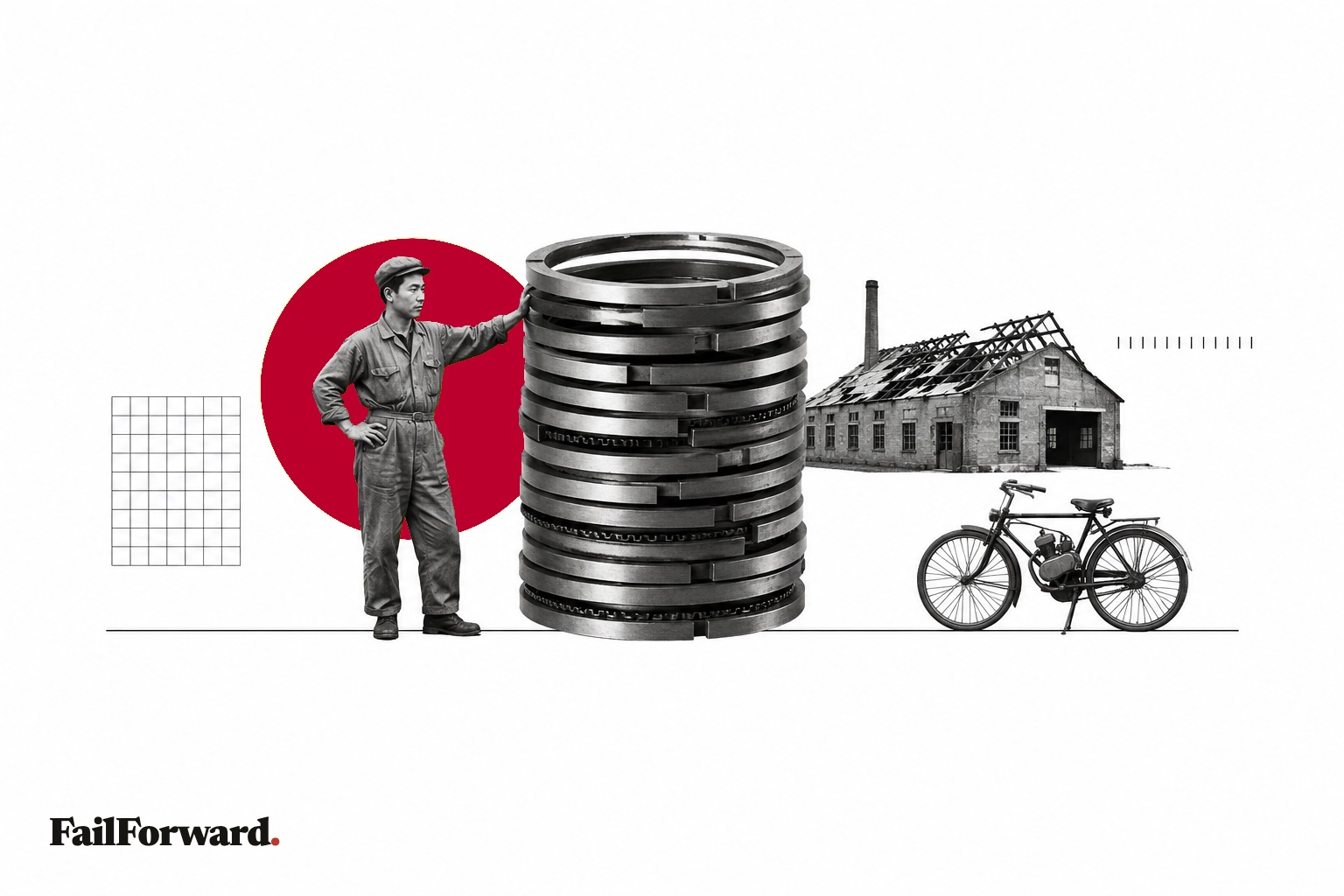
In 1937 Soichiro Honda was thirty and done with fixing other people's cars. He had run a successful repair shop in Hamamatsu, invented a lift so mechanics would not have to work on their backs, and decided that repair work was beneath his ambitions. He wanted to make something. He chose piston rings, and he chose a single customer to make them for: Toyota.
The first batch went to Toyota's quality control. Of fifty rings, three passed. The rest were rejected outright — too brittle, wrong composition, useless in an engine.
“Success can only be achieved through repeated failure and introspection. In fact, success represents the 1% of your work which results only from the 99% that is called failure.”
Soichiro HondaHonda's response was not to argue. It was to admit that he did not know enough. At an age when his competitors were running factories, he enrolled as a part-time student at the Hamamatsu Industrial Institute to study metallurgy, working at the shop by day and sitting in lectures on casting and alloys. He spent the better part of two years going between the classroom, university laboratories and steel companies, asking why his rings kept failing.
They stopped failing. Tokai Seiki got the Toyota contract, then a second one from Nakajima Aircraft, and by the early 1940s Honda was running a real manufacturer with wartime orders and machines he had designed himself when he could not buy them.
Then it all went. In 1944 an American B-29 raid destroyed the Yamashita plant. What was left of production moved to Iwata, and in January 1945 the Mikawa earthquake brought that building down too. The rings, the machines, the years of study — all of it under rubble within a few months.
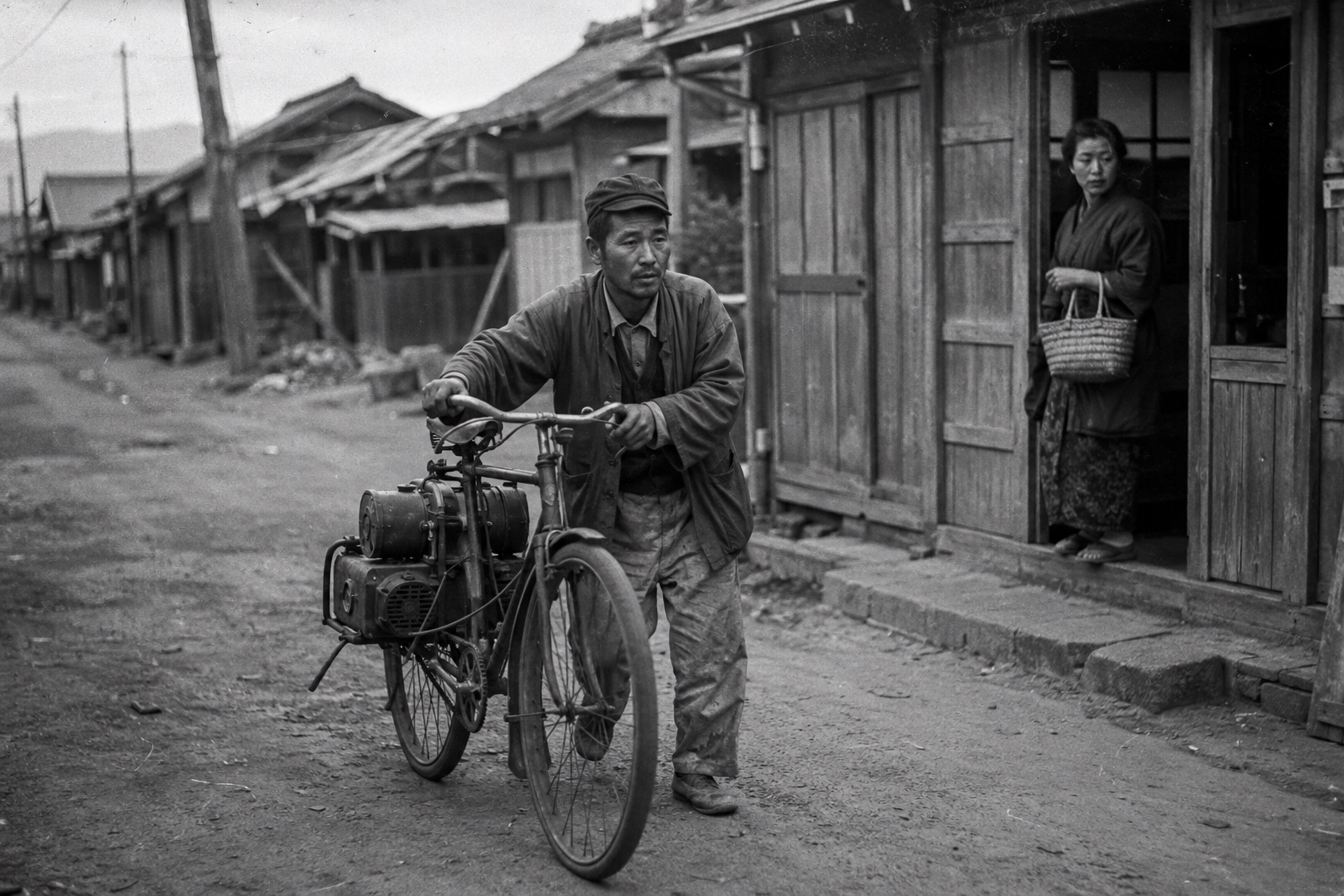
Honda sold the remains of Tokai Seiki to Toyota for 450,000 yen and, by his own account, spent the next year doing nothing much at all. He called it his "human holiday": he made salt from seawater, he drank, he waited for an idea.
The idea, when it came, was almost humiliatingly small. Japan had no fuel and no working transport, and Honda had a pile of surplus military radio generator engines nobody wanted. He bolted one to a bicycle so his wife could get to the market without queuing for trains. Neighbours asked for their own. He founded the Honda Technical Research Institute in October 1946 in a wooden shed, and by 1948 the Type A motorised bicycle carried the first engine Honda had designed and mass-produced himself.
Eleven years after three rings out of fifty passed inspection, the company that grew out of that shed was building the Dream. Within fifteen years it was outselling Triumph and Harley-Davidson in America many times over.
Questions
How many piston rings did Toyota reject from Soichiro Honda?
All but three of the first fifty. Toyota rejected the rest of Tokai Seiki's first batch as too brittle and of the wrong composition, so Soichiro Honda went back to school at 31 to study metallurgy.
What happened to Tokai Seiki?
Bombing and an earthquake finished off Tokai Seiki: a 1944 American B-29 raid wrecked the Yamashita plant, and in January 1945 the Mikawa earthquake brought down the Iwata building. Soichiro Honda sold the remains to Toyota for 450,000 yen.
How was Honda founded?
With a surplus military radio generator engine that Soichiro Honda bolted to a bicycle so his wife could get to the market. Neighbours asked for their own, and in October 1946 he founded the Honda Technical Research Institute in a wooden shed.